| | 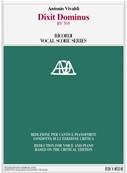 The Dixit Dominus RV 595 shares a key and some further characteristics with the better-known setting of the same psalm, RV 594, but differs from it markedly: first, in being scored for an undivided ensemble (i.e., not “in due cori”): second, in belonging to Vivaldi’s first period of sacred music composition, around 1715, rather than to a later period. There are stylistic parallels, too, with Vivaldi’s two Gloria settings, RV 588 and RV 589. Three of the eleven movements making up RV 595 use borrowed material, which in two instances is taken from movements by unknown composers in Vivaldi’s own collection, and in one instance (heavily disguised), from a published madrigal (1705) by Antonio Lotti. The borrowings are absorbed extremely well into the fabric of the setting and do not disrupt its well-unified character. Among the high points of RV 595 are its opening pair of moments – the first bustling and the second poignantly reflective – and the fourth movement, “Tecum principium”, where two obbligato cellos enter into dialogue with two sopranos. This Dixit Dominus, preserved uniquely in Prague, ranks among Vivaldi’s finest large-scale sacred vocal compositions. The Introduction and Critical Commentary for this vocal score are based on the Critical Edition by Michael Talbot published in 1993. The Dixit Dominus RV 595 shares a key and some further characteristics with the better-known setting of the same psalm, RV 594, but differs from it markedly: first, in being scored for an undivided ensemble (i.e., not “in due cori”): second, in belonging to Vivaldi’s first period of sacred music composition, around 1715, rather than to a later period. There are stylistic parallels, too, with Vivaldi’s two Gloria settings, RV 588 and RV 589. Three of the eleven movements making up RV 595 use borrowed material, which in two instances is taken from movements by unknown composers in Vivaldi’s own collection, and in one instance (heavily disguised), from a published madrigal (1705) by Antonio Lotti. The borrowings are absorbed extremely well into the fabric of the setting and do not disrupt its well-unified character. Among the high points of RV 595 are its opening pair of moments – the first bustling and the second poignantly reflective – and the fourth movement, “Tecum principium”, where two obbligato cellos enter into dialogue with two sopranos. This Dixit Dominus, preserved uniquely in Prague, ranks among Vivaldi’s finest large-scale sacred vocal compositions. The Introduction and Critical Commentary for this vocal score are based on the Critical Edition by Michael Talbot published in 1993.
Minimum delivery time 2 to 3 weeks.
|
| | | 
Voice and piano reduction for the setting of Psalm 109, composed for soli soprano, contralto, tenor, SATB choir, oboe, trumpet, violin, viola and bass.
Minimum delivery time 2 to 3 weeks. |
| | |  A circumstance work, originally written to celebrate the bicentenary of the french revolution in 1789, which compares the momentum of the people who is released from the yoke to a genie that comes out of his lamp, hence the title "Djinn".But far beyond, it is in fact a masterful work that Xavier le Masne wrote, celebrating freedom, equality and fraternity, thanks to the words of Jean Mazeaufroid whose poem is tremendously embedded in music.The work is for mixed choir and orchestra (hire material), with possibility of different nomenclatures.Note: the score is handwritten, it includes spoken parts, clusters, tanks, mixing tessitures or letting each individual voice emit sounds that create a sculptural acoustic bunch, alternating with more traditional singing parts with four voices.Instrumentation, available on request (hire material):violins 1, violins 2, violas 1, violas 2, cellos 1, cellos 2, trumpets 1, trumpets 2, horns 1, horns 2, trombone, tuba, percussion 1, percussion 2.A work to rediscover that mostly resonate today. A circumstance work, originally written to celebrate the bicentenary of the french revolution in 1789, which compares the momentum of the people who is released from the yoke to a genie that comes out of his lamp, hence the title "Djinn".But far beyond, it is in fact a masterful work that Xavier le Masne wrote, celebrating freedom, equality and fraternity, thanks to the words of Jean Mazeaufroid whose poem is tremendously embedded in music.The work is for mixed choir and orchestra (hire material), with possibility of different nomenclatures.Note: the score is handwritten, it includes spoken parts, clusters, tanks, mixing tessitures or letting each individual voice emit sounds that create a sculptural acoustic bunch, alternating with more traditional singing parts with four voices.Instrumentation, available on request (hire material):violins 1, violins 2, violas 1, violas 2, cellos 1, cellos 2, trumpets 1, trumpets 2, horns 1, horns 2, trombone, tuba, percussion 1, percussion 2.A work to rediscover that mostly resonate today. |
| | |  - - |
|
|