| |  This sheet music was created on June 11, 1994, and supervised by Luc Guilloré. It can be performed by mixed voices, small female or children’s choirs and accompanied on the piano. This sheet music is short but incredibly intense. It suggests a deep reflection explained by Patrice Libes: “Thousands of sounds we can’t heat fill the world. If we consciously listen to them from the inside of our innermost being, does not that mean that we actually are a vibration? Does it not mean we can hold for a moment this harmony thanks to which our life is so intense?”Patrice Libes is a composer and won 1st prizes at Conservatoire de Paris for his writing and orchestrating, studying with Serge Nigg. He teaches notation and harmony in École Nationale de Musique et de Danse de Brive. He conducts choirs of third-year and intensive foundation degree students at the Ensemble Vocal Cantabile in Brive-la-Gaillarde.Charles Van Lerberghe was born in Gand in 1861, and he passed away in Bouillon, Belgium, in 1907. He was the student of Maurice Maeterlinck and was part from the literary movement La Jeune Belgique. This movement has artistic similarities with Sully Prudhomme and Stéphane Mallarmé. He had a so flowing writing that he was nicknamed “poète au crayon d’or” (the gold pen poet). This sheet music was created on June 11, 1994, and supervised by Luc Guilloré. It can be performed by mixed voices, small female or children’s choirs and accompanied on the piano. This sheet music is short but incredibly intense. It suggests a deep reflection explained by Patrice Libes: “Thousands of sounds we can’t heat fill the world. If we consciously listen to them from the inside of our innermost being, does not that mean that we actually are a vibration? Does it not mean we can hold for a moment this harmony thanks to which our life is so intense?”Patrice Libes is a composer and won 1st prizes at Conservatoire de Paris for his writing and orchestrating, studying with Serge Nigg. He teaches notation and harmony in École Nationale de Musique et de Danse de Brive. He conducts choirs of third-year and intensive foundation degree students at the Ensemble Vocal Cantabile in Brive-la-Gaillarde.Charles Van Lerberghe was born in Gand in 1861, and he passed away in Bouillon, Belgium, in 1907. He was the student of Maurice Maeterlinck and was part from the literary movement La Jeune Belgique. This movement has artistic similarities with Sully Prudhomme and Stéphane Mallarmé. He had a so flowing writing that he was nicknamed “poète au crayon d’or” (the gold pen poet). |
| | | 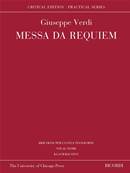
Ricordi, the well-known printer of classical opera, presents the works of the great opera composers in its CRITICAL EDITION · PRACTICAL SERIES.
These revised definitive scores are produced by using all the currently available sources ranging from the original autographs to printed editions, in line with strict philological and critical criteria.
Each edition has a brief introduction providing the historical context for the opera in question.
This series combines the rigour of a critical approach and a practical, easy-to-follow editorial lay-out.
Minimum delivery time 2 to 3 weeks. |
| | | 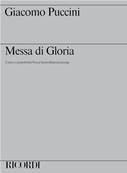
Puccini's Messa di Gloria was created in 1880 as a final thesis at the Lucca Conservatory, in which he handled two pieces, a Motet and a Credo, which he had composed 2 years earlier.
The first performance on July 12, 1880 was a great success for the young Puccini, who was attached to this early work: echoes of the Messa can later be found in his operas, especially in Edgar and Manon Lescaut.
The piano reduction replaces here the orchestra part.
Minimum delivery time 2 to 3 weeks.
|
| | | 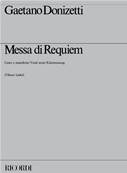
Messa da requiem in D minor (1835) is a musical setting of the Catholic funeral mass (Requiem) by Italian opera composer Gaetano Donizetti.
It is scored for five soloists (SATB and a baritone), mixed choir and orchestra.
A performance lasts about 62–75 minutes.
Minimum delivery time 2 to 3 weeks. |
|
|