| | 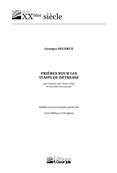 This is a work for mixed choirs, baritone solos and instrumental ensembles. It is based on the Bible, liturgical texts, and texts of great biblical tragedies. There are songs and prayers in response to war, deportation and genocide. It is written in Latin with a simple and tonal musical language, so it can be performed by mass choirs without any trick or rhythmic difficulties. This is a work for mixed choirs, baritone solos and instrumental ensembles. It is based on the Bible, liturgical texts, and texts of great biblical tragedies. There are songs and prayers in response to war, deportation and genocide. It is written in Latin with a simple and tonal musical language, so it can be performed by mass choirs without any trick or rhythmic difficulties. |
| | |  A work by Georges Delerue, not as well-known as his musics for the cinema, but a highly emotionnal piece.Work for mixed choir, solo baritone and instrumental ensemble on a text taken from the Bible and the liturgy. It is a work of liturgical character with texts of great biblical tragedies, as well as songs and orations. War, deportation and genocide are exposed and answered through prayer. This work in Latin is written in a simple and tonal musical language, so that it can be sung by large choral masses who will not find harmonic traps or rhythmic complexities.Orchestral parts on hire.3 parts in this cantata : The war (circa 7 minutes), The deportation (circa 9 minutes), The genocide (circa 6 minutes). A work by Georges Delerue, not as well-known as his musics for the cinema, but a highly emotionnal piece.Work for mixed choir, solo baritone and instrumental ensemble on a text taken from the Bible and the liturgy. It is a work of liturgical character with texts of great biblical tragedies, as well as songs and orations. War, deportation and genocide are exposed and answered through prayer. This work in Latin is written in a simple and tonal musical language, so that it can be sung by large choral masses who will not find harmonic traps or rhythmic complexities.Orchestral parts on hire.3 parts in this cantata : The war (circa 7 minutes), The deportation (circa 9 minutes), The genocide (circa 6 minutes). |
| | |  - - |
| | |  Psalm 150 was composed in 1984 for the inauguration of the Institution des Jeunes Aveugles de Paris’ organ. César Franck supervised the musical training and presided over the annual competition. It was firstly published by Breitkopf in 1896 with a German text. It was first written for woodwind instruments, timbales, harps, choirs, string instruments and organs. The text is sung by every voice. Voices are intertwined until the incredible conclusion. Psalm 150 was composed in 1984 for the inauguration of the Institution des Jeunes Aveugles de Paris’ organ. César Franck supervised the musical training and presided over the annual competition. It was firstly published by Breitkopf in 1896 with a German text. It was first written for woodwind instruments, timbales, harps, choirs, string instruments and organs. The text is sung by every voice. Voices are intertwined until the incredible conclusion. |
|
|